
This post is part of the GNHRE Blog Symposium, The Unmaking of the European Green Deal.
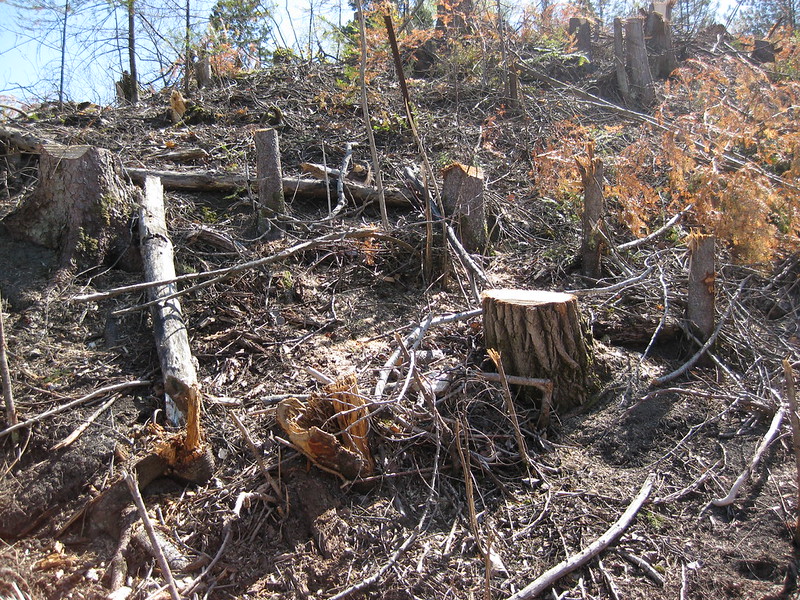
“Deforested” by Peter Blanchard is licensed under CC BY 2.0.
Introduction
In November 2021, the European Commission proposed what became Regulation (EU) 2023/1115 on deforestation-free products (the EU Deforestation Regulation) as part of the European Green Deal, which aims to make Europe the first climate-neutral continent by 2050. The Regulation was adopted by the European Parliament and the Council on 31 May 2023, and entered into force on 29 June 2023.
The Regulation was originally due to apply from 30 December 2024. Following pressure from Member States, businesses and trading partners, the European Commission proposed a 12-month delay, and Regulation (EU) 2024/3234 postponed its date of application to 30 December 2025 and, for operators that were micro or small undertakings, to 30 June 2026. Regulation (EU) 2025/2650 introduced a further postponement of the date of application and also amended substantive provisions of the original Regulation. The amended Regulation now applies from 30 December 2026 and, for operators that, by 31 December 2024, were established as natural persons or as micro or small undertakings, from 30 June 2027.
These delays and amendments reflect the alleged challenges associated with the implementation of the Regulation’s requirements, but also raise concerns about the EU’s commitment to addressing deforestation and about its broader implications for the rule of law and human rights.
This blog post provides an overview of the Regulation as originally adopted, namely Regulation (EU) 2023/1115. It further discusses the Regulation’s potential contribution to climate change mitigation. The blog post concludes with a discussion of how the amendments to the Regulation raise questions about legal certainty, non-regression and the EU’s compliance with international obligations and the direction of EU environmental governance.
Before the Unmaking: the Original Regulation and its Environmental Ambition
In its original formulation, Regulation (EU) 2023/1115 targeted seven ‘relevant commodities’ that are major drivers of deforestation (cattle, cocoa, coffee, oil palm, rubber, soya and wood) and certain products derived from them (‘relevant products’). It included three main obligations for operators placing relevant products on the Union market or exporting them. First, operators had to demonstrate that the products were ‘deforestation-free’, that is, produced on land that had not been subject to deforestation after 31 December 2020 (and, for wood, harvested without inducing forest degradation after that date). Second, operators had to demonstrate thatthe products were produced in accordance with the ‘relevant legislation of the country of production’, which covers, among other things, land-use rights, environmental protection, labour rights, human rights protected under international law and the principle of free, prior and informed consent. Third, operators had to submit a due diligence statement confirming that the products met these requirements.These requirements applied to both imports and exports, ensuring that the EU’s standards applied to the global supply chains of all regulated operators.
Central to the original Regulation was the obligation to exercise due diligence, which required operators to trace their supply chains and verify that relevant products met these requirements. This involved collecting the geolocation of the plots of land where the relevant commodities were produced and maintaining transparent supply chains.
The Regulation also established a risk assessment framework, requiring operators to assess the risk that relevant products were non-compliant. The criteria to be considered included the risk of deforestation in the country of production or parts thereof, the presence of Indigenous Peoples, and the complexity of the supply chain. Unless the risk was found to be negligible, operators had to adopt risk mitigation measures, such as requiring additional information or documents, or carrying out independent surveys or audits, so as to reach no or only negligible risk.
This approach aimed to reduce the EU’s contribution to global deforestation by making supply chains more transparent and accountable. By preventing deforestation-linked products from entering the EU market, the Regulation was expected to reduce carbon emissions associated with forest loss.
The Regulation’s Contribution to Global Climate Change Mitigation
The Regulation targets emissions embedded within international supply chains, an area traditionally challenging to regulate because of the complexity and globalisation of commodity production. By introducing mandatory due diligence requirements and restricting products linked to deforestation from entering the EU market, the Regulation addresses an important source of land-use emissions. Its influence may also extend beyond the EU if other major consumer markets adopt comparable measures. Prior to the adoption of the Regulation, the United States’ Lacey Act, Australia’s Illegal Logging Prohibition Act 2012 and the EU Timber Regulation (EUTR) had already established trade-related measures targeting illegally harvested timber and timber products. Regulation (EU) 2023/1115 repeals the EUTR, which nonetheless continues to apply until the new rules become applicable and, on a transitional basis, to certain timber products thereafter. The EU Deforestation Regulation differs from these measures because it requires products to be deforestation-free, irrespective of whether the deforestation was legal in the country of production. The UK has also legislated for a forest-risk commodities regime under Schedule 17 of the Environment Act 2021, which is legality-based and requires due diligence, but which is not yet operational because the necessary secondary legislation has not yet been made. The UK Government has announced a further consultation and expects to legislate in 2027. These measures demonstrate that regulatory responses to forest-risk commodities have developed across jurisdictions. Since all of them predate the EU Deforestation Regulation, they also show that it builds on an earlier trajectory of trade-based forest governance, its deforestation-free requirement being its distinctive contribution.
Regulatory diffusion is not uncontested. On 22 November 2022, a joint statement to the WTO Committee on Agriculture delivered by Indonesia on behalf of 14 Members, including Brazil, Malaysia, Argentina, Paraguay, Ecuador, Thailand, Guatemala, Nigeria, Colombia and Côte d’Ivoire, expressed concerns about the then-proposed regulation’s unilateral approach, benchmarking mechanism, and traceability and geolocation requirements, particularly for smallholders. Such objections suggest that the diffusion of this type of regulation cannot be assumed and may depend on whether its requirements are regarded as legitimate and practicable by affected producer countries.
If comparable measures nevertheless continue to emerge across major consumer markets, their cumulative effect could extend the Regulation’s influence beyond its direct emissions impact and contribute to broader efforts to meet the Paris Agreement’s temperature goals. Thus, while the Regulation’s direct contribution to emission reductions may be modest relative to global mitigation requirements, its potential significance also lies in its capacity to influence the wider development of trade-based climate and forest governance.
The Unmaking of the EU Deforestation Regulation and its potential meaning for the direction of EU environmental governance.
Recent amendments to the Regulation have reduced the breadth and intensity of the regulatory regime while formally retaining its central objective of combating deforestation and forest degradation. Regulation (EU) 2025/2650 substantially shifted compliance responsibilities upstream: downstream operators and traders generally no longer have to conduct their own full due diligence or submit their own due diligence statements, while micro or small primary operators may submit a one-off simplified declaration instead of due diligence statements. Printed products, such as books and newspapers, were also removed from the scope. As noted above, it also postponed the date of application to 30 December 2026 and, for operators established as natural persons or as micro or small undertakings, to 30 June 2027.
The narrowing of the Regulation’s material scope continued through a separate act. Commission Delegated Regulation (EU) 2026/2102 of 13 July 2026, published in the Official Journal of the European Union in September 2026, amended Annex I by removing several products, including cattle hides, skins and leather, retreaded tyres, soybeans intended for sowing, certain vulcanised-rubber articles, conveyor and transmission belts, and aircraft and motor-vehicle seats, while adding a limited number of products, including soluble coffee, frozen cattle tongues and certain palm-oil derivatives, which will be covered from 30 December 2027.
The effects of these amendments must also be considered alongside the Regulation’s country benchmarking system, which differentiates due diligence obligations according to country risk. Commission Implementing Regulation (EU) 2025/1093 established the first official country-risk classifications under Article 29 of the original Regulation, assigning countries to low-, standard- or high-risk categories. Only four countries—Belarus, the Democratic People’s Republic of Korea, Myanmar and the Russian Federation—were classified as high risk, while the vast majority were classified as low or standard risk. This allows operators placing on the market relevant products made from commodities produced exclusively in low-risk countries to benefit from simplified due diligence under Article 13 of the Regulation. Taken together, the changes to the Regulation’s product coverage, the allocation of compliance responsibilities and the differentiation of due diligence obligations illustrate the extent to which the original regulatory framework has been recalibrated.
Against the backdrop of repeated amendments, postponements and uncertainty surrounding the Regulation’s application, the Commission’s simplification review of 4 May 2026 (COM(2026) 191) ruled out further delay, while claiming that the simplification measures would reduce compliance costs by approximately 75% compared with the original Regulation.
The Commission’s simplification approach reflects a broader pattern examined in this GNHRE symposium on the unmaking of the European Green Deal: a possible coherent deregulatory turn, pursued through postponement, narrowing of scope and the shifting of obligations along the value chain. In the case of the EU Deforestation Regulation, these techniques operate cumulatively. Narrowing the product scope removed certain downstream products from direct regulatory control; reducing downstream due-diligence obligations limits the number of actors required to independently identify and manage deforestation risks; and postponing application delays the Regulation’s environmental effects. The exclusion of cattle-derived leather is particularly relevant because it disconnects an important downstream product from controls attached to the cattle commodity, potentially reducing the Regulation’s ability to exert pressure throughout the supply chain. Thus, the amendments preserve the Regulation’s formal environmental objective while reducing its regulatory reach, supply-chain coverage, and immediacy, creating a less comprehensive mechanism for translating EU consumption into pressure against global deforestation.
The retrenchment of the Regulation is not an isolated technical exercise; it reflects a systematic prioritisation of simplification and competitiveness to the detriment of environmental responsibility, human rights and climate action. As this symposium shows, this systemic prioritisation is further illustrated by the European Commission’s Omnibus reform of significant parts of the Green Deal’s regulatory architecture, including the Corporate Sustainability Reporting Directive (CSRD), the Corporate Sustainability Due Diligence Directive (CSDDD), and the Carbon Border Adjustment Mechanism (CBAM), under the banner of simplification and competitiveness.
The unmaking of the EU Deforestation Regulation raises broader questions concerning the rule of law in the EU, environmental protection and climate obligations. The European Commission identifies legal certainty as a core principle of the rule of law, while CJEU case law recognises the protection of legitimate expectations as a related principle (Joined Cases C‑180/18, C‑286/18 and C‑287/18 Agrenergy and Fusignano Due, EU:C:2019:605, paras 29–31). The CJEU, however, sets a high bar: a prudent and alert economic operator cannot normally rely on the maintenance of an existing situation that the EU institutions may alter in the exercise of their discretion. Nevertheless, repeated amendments and postponements adopted shortly before scheduled application dates raise concerns about legal certainty and predictability for everyone affected: operators who invested early, producer countries and smallholders, and communities. These concerns are particularly significant where affected parties have already made preparations in reliance on the original requirements. Notably, both amending regulations were published in the Official Journal only a week before the date on which the Regulation was due to apply (on 23 December 2024 and 23 December 2025 respectively).
Furthermore, the ECtHR’s judgment in Verein KlimaSeniorinnen Schweiz v Switzerland (Grand Chamber, App. no. 53600/20, 9 April 2024) held that States must establish and effectively apply a regulatory framework capable of mitigating climate change. Although the EU is not a party to the ECHR, the judgment is relevant here because all 27 Member States are Contracting Parties to the Convention as interpreted by the Court, and Article 52(3) of the Charter requires Charter rights that correspond to Convention rights to be given the same meaning and scope as those laid down by the Convention. The ICJ’s Advisory Opinion of 23 July 2025 on the Obligations of States in respect of Climate Change clarified that States’ customary international law duty to prevent significant environmental harm requires stringent due diligence, including adopting and effectively enforcing regulatory measures addressing public and private activities contributing to greenhouse gas emissions. Although these authorities do not establish that the Regulation must remain unchanged, they raise the question of how regulatory simplification can be reconciled with effective climate and environmental protection and the human rights of Indigenous and forest-dependent communities.
The retrenchment of the Regulation also raises questions about the consistency of the amended framework with the EU’s broader environmental commitments. This concern must, however, be distinguished from the question of whether the amendments violate a legally binding principle of non-regression. Although non-regression is not expressly codified as a general principle in EU law, it may be argued to derive from Article 3(3) TEU, which identifies a high level of environmental protection and the improvement of environmental quality as Union objectives; Article 191 TFEU, which establishes the objectives and principles of EU environmental policy; and Article 37 of the Charter of Fundamental Rights, which requires a high level of environmental protection and the improvement of the quality of the environment to be integrated into the policies of the Union and ensured in accordance with the principle of sustainable development. The Commission’s 2019 Communication, Stepping up EU Action to Protect and Restore the World’s Forests (COM(2019) 352 final), further articulates the Union’s policy commitments to protecting and restoring forests and addressing deforestation associated with EU consumption and production.
Against this background, the question is not simply whether each amendment, considered in isolation, breaches a legally binding obligation of non-regression, but whether their cumulative effect signals a broader retreat from the Union’s previously stated environmental ambitions. As discussed above, the amendments have largely prioritised simplification and competitiveness rather than strengthening the Regulation’s environmental ambition. In my view, this raises concerns that the commitment to a high level of environmental protection is increasingly being subordinated to competing regulatory and economic priorities. The concern is particularly significant given the original Regulation’s already limited projected contribution to climate change mitigation: the Commission estimated that it would cut carbon emissions by at least 32 million tonnes per year, a small fraction of the reductions needed globally by 2030 to limit warming to 1.5°C. If a framework with such a modest projected global contribution is subsequently weakened rather than strengthened, the cumulative amendments warrant scrutiny not only as a retreat from the original Regulation’s ambition, but also as a possible manifestation of a broader deregulatory turn within the European Green Deal.
Yet this is not a moment for resignation. When environmental protection faces mounting political and economic pressures, the need for sustained commitment becomes more—not less—urgent. The defence of human rights, including the human right to a clean, healthy and sustainable environment, requires renewed public consciousness, solidarity and collective action to sustain the environmental transformation that the European Green Deal set out to advance.