
By Héctor Herrera and Rafaella Sena Pinto
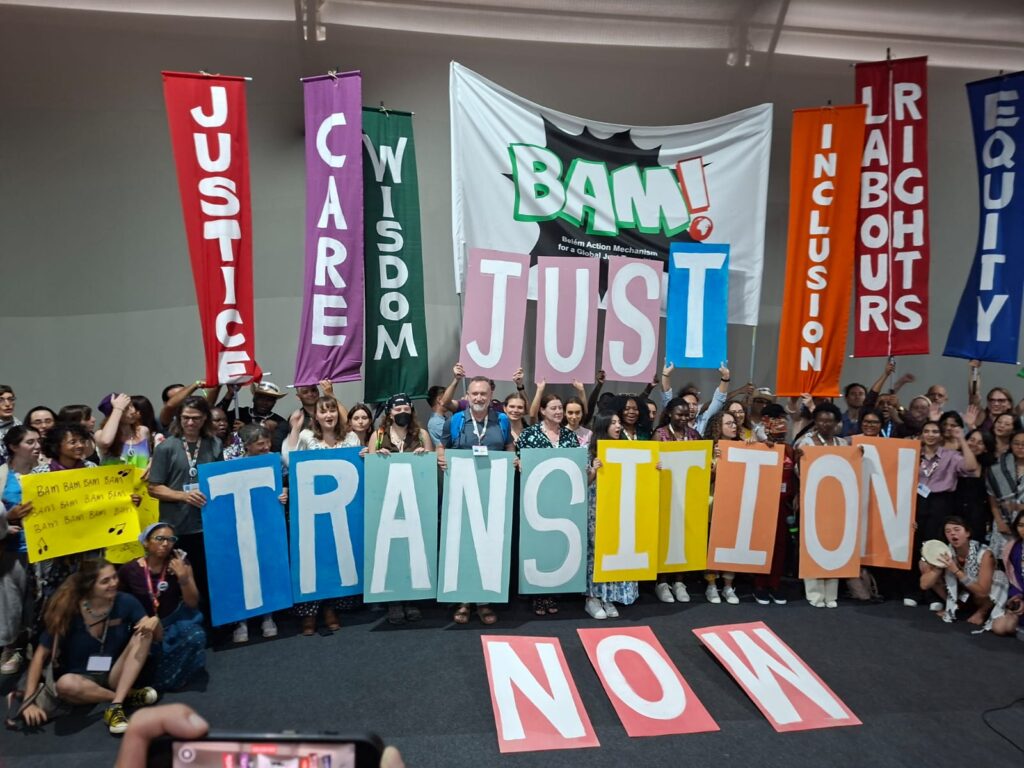
Photo credit: Rafaella Sena Pinto. Demonstrators express support for the Belém Action Mechanism (BAM) for a Global Just Transition during a public mobilization in Belém do Pará, Brazil.
On 15 November 2025, thousands of people from across Brazil and around the world gathered in the Amazonian city of Belém do Pará during COP30 on climate change. As part of the Great Peoples’ March, participants staged a symbolic “funeral” for fossil fuels, a powerful performative act reflecting the growing global demand to advance a just transition away from coal, oil, and gas.
A just transition away from fossil fuels rests on a premise firmly grounded in scientific consensus: limiting global temperature rise to 1.5°C requires rapid and sustained reductions in both the extraction and consumption of fossil fuels. Yet progress cannot be assessed solely in terms of emission reductions. It must also incorporate a climate justice and human rights perspective, addressing historical inequalities, the distribution of burdens and benefits, and the protection of affected communities and territories. In this sense, COP30 unfolded not only as a diplomatic negotiation arena but also as a site of contestation over responsibility, equity, and the pace of fossil fuel phase-out.
In the “Mutirão” decision adopted at the COP30 closing plenary on 22 November 2025, Parties failed to reach consensus on including explicit provisions for the phase-out of fossil fuels. In response, the Brazilian Presidency announced the development of a roadmap to guide a just and equitable transition away from fossil fuels, with outcomes to be presented at COP31 in Turkey. Likewise, within the broader framework of COP discussions, the Belém Action Mechanism (BAM), an initiative promoted by a coalition of governments and civil society actors, was debated and advanced as a complementary platform aimed at sustaining momentum on the global just transition.
The Belém Declaration and the International Legal Framework
Parallel to the formal negotiations, the Belém Declaration on the Transition Away from Fossil Fuels was launched and endorsed by at least 24 countries, including Australia, Cambodia, Colombia, Fiji, Jamaica, Kenya, the Netherlands, and Tuvalu. The Declaration is not a COP decision; rather, it is a political initiative outside the formal consensus process that seeks to give political impetus to a just transition and sets out key principles, including the need for an explicit commitment to fossil fuel phase-out and respect for the rights of workers and Indigenous Peoples. The Declaration reaffirms the collective determination to pursue a “just, orderly and equitable” transition consistent with the 1.5°C goal. It emphasizes:
• The need to accelerate the deployment of renewable energy and energy efficiency to replace fossil fuel–based capacity.
• The obligation to support workers and vulnerable communities in countries dependent on fossil fuel industries through reskilling, economic diversification, and social protection measures.
• Respect for the rights of Indigenous Peoples and the promotion of resilient societies.
• The relevance of the Advisory Opinion of the International Court of Justice (ICJ) on States’ obligations in relation to climate change.
By explicitly referencing the ICJ Advisory Opinion, the Belém Declaration situates its political commitments within an emerging international legal framework. Rather than presenting the transition away from fossil fuels solely as a matter of political discretion, it aligns itself with judicial interpretations that increasingly frame climate inaction and continued fossil fuel expansion as matters of legal responsibility.
The Advisory Opinion of the ICJ affirms that States have obligations under international law to protect the climate system and the environment from anthropogenic greenhouse gas (GHG) emissions. It recognizes that the burning of fossil fuels constitutes the primary source of anthropogenic CO₂ and a significant source of methane, and links these emissions to obligations arising under both climate treaties and human rights instruments. In clear terms, the ICJ states that “Failure of a State to take appropriate action to protect the climate system from GHG emissions — including through fossil fuel production, fossil fuel consumption, the granting of fossil fuel exploration licences or the provision of fossil fuel subsidies — may constitute an internationally wrongful act which is attributable to that State.” (P 122, 2025).
At the regional level, the Inter-American Court of Human Rights has also contributed to this evolving normative framework through its Advisory Opinion on the climate emergency and human rights also released in 2025. In that opinion, the Court calls upon States to regulate fossil fuel exploration and exploitation as part of their human rights obligations and highlights that the energy transition must be designed in a manner consistent with the effective protection of those rights. Taken together, these advisory opinions consolidate an emerging jurisprudential consensus: the transition away from fossil fuels is not merely a policy choice, but a matter increasingly framed within binding legal obligations.
2025: Judicial Clarifications and Political Commitments
The year 2025 marked a significant moment in the consolidation of international climate governance related to the just transition away from fossil fuels. The Advisory Opinions of both the ICJ and the Inter-American Court of Human Rights have charted an emerging international roadmap linking the transition away from fossil fuels to the interpretation and clarification of binding international legal obligations grounded in human rights and equity. These judicial clarifications are complemented by the political commitment expressed by an initial group of States through the 2025 Belém Declaration. These legal and political developments represent meaningful steps toward advancing fossil fuel phase-out.
The process initiated through the Belém Declaration will continue in 2026 with a high-level event to be held on 28–29 April in the port city of Santa Marta, Colombia, co-hosted by Colombia and the Netherlands. The meeting aims to strengthen international cooperation to advance the transition away from fossil fuels, reinforce the objectives of the Paris Agreement, and align policy action with the obligations identified by the ICJ. Discussions in Santa Marta are expected to inform deliberations and decision-making processes concerning a just transition at COP31 in Turkey. Whether these political commitments crystallize into more formalized multilateral outcomes is a relevant and consequential question.
Toward COP31: Climate Justice and Human Rights as a Compass
Political recognition of the need to progressively move away from fossil fuels is becoming more visible across multiple fora, though it remains fragmented and uneven in legal effect.The immediate challenge is not merely technical or financial, but normative and ethical: ensuring that the transition is designed and implemented through the lens of climate justice, with full respect for and protection of human rights, especially for those communities that have historically borne the environmental and social burdens associated with fossil fuel extraction and use.
The Advisory Opinions of the ICJ and the Inter-American Court of Human Rights provide a robust legal framework, and the Belém Declaration reflects a political commitment by an initial group of countries. The next step is to translate these normative frameworks and commitments into concrete public policies, adequate financing mechanisms, and effective participatory processes that place affected communities and territories at the center of a just energy transition. Whether COP31 consolidates these emerging normative and political dynamics will be an important test of the international community’s willingness to align climate governance with human rights, intergenerational equity, and energy transition.
References:
Belém Declaration on the Transition Away from Fossil Fuels. 2025. https://oeco.org.br/wp-content/uploads/2025/11/BELEM-DECLARATION-ON-THE-TRANSITION-AWAY-FROM-FOSSIL-FUELS-Adobe-cloud-storage.pdf
Climate Action Network International. 2025. COP 30 takes a hopeful step towards justice, but does not go far enough. https://climatenetwork.org/2025/11/22/cop30-takes-a-hopeful-step-towards-justice-but-does-not-go-far-enough/
Inter-American Court of Human Rights. Advisory Opinion AO-23/25 of May 29, 2025. Climate Emergency and Human Rights. https://www.corteidh.or.cr/docs/opiniones/seriea_32_en.pdf
International Court of Justice (ICJ). Advisory Opinion of 23 July 2025. Obligations of the States in respect of Climate Change. https://www.icj-cij.org/case/187/advisory-opinions
IISD. 2025. Challenging COP 30 Talks Elude Consensus on Fossil Fuels, Deforestation. https://sdg.iisd.org/news/challenging-cop-30-talks-elude-consensus-on-fossil-fuels-deforestation/
Governments of Colombia and The Netherlands Announce Co-hosting First International Conference on the Just Transition Away from Fossil Fuels as COP30 Text Drops with No Mention of Fossil Fuels. 2025. https://www.fossilfueltreaty.org/first-international-conference